
Sacred Animal Cults in Ancient Egypt
- 2月4日
- 讀畢需時 3 分鐘
已更新:2月4日
Since the Predynastic Period (about 4000 BC to 3200 BC), sacred animal cults reached unprecedented heights among Ancient Egyptians. Instead of worshipping animals, they regarded certain animals as earthly incarnations or emissaries of gods and goddesses. Most deities were anthropomorphised, but they retained their heads as a defining feature of divine hybridism.


While Bastet was a war goddess depicted as a fierce lioness, she gradually transitioned into a gentle domestic cat, closely associated with fertility and the protection of the household. During the annual Festival of Bastet, devotees would feast and offer statues and cat mummies to the goddess Bastet at her temples, seeking her blessings and giving thanks for her favour.




Thoth, the deity of the moon, wisdom, and medicine, had two manifestations of the lunar symbolism: the baboon with its cries at dawn was believed to be the moon god's incarnation paying homage to the rising sun. The ibis's long curved beak mirrored the crescent moon, while its contrasting black-and-white plumage was seen as the moon's waxing and waning phases.
The cult centre of the crocodile god Sobek was in the Fayum region. In the Middle Kingdom period, through syncretism with the falcon god Horus, his worship transcended regional boundaries and gradually attained greater prominence throughout Egypt. This statue represents Horus, who transformed into a crocodile to retrieve the body of his father, Osiris, from the river.
Symbolising dominion over the sky and kingship, Horus appears in the form of a falcon or a man with a falcon's head. With the emergence of the first king of Ancient Egypt around 3000 BC, the ruler was considered the earthly incarnation of Horus. To celebrate the pharaoh's sacred role as the intermediary between humans and gods, statues of Horus were displayed in the temples.

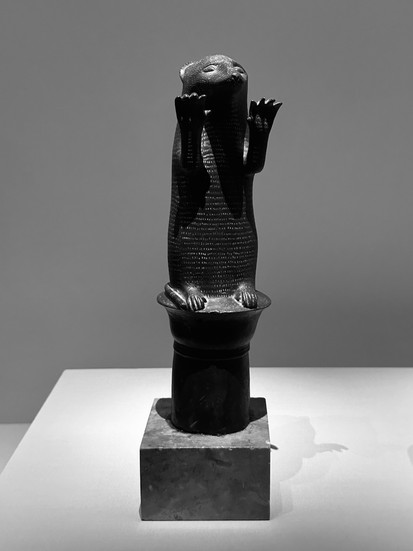


In Egyptian mythology, Apep was a giant serpent symbolising chaos and darkness, who sought to prevent Re from bringing sunrise and light as he travels the underworld on his solar barque. Mongoose, a masterful predator of snakes, was seen by the Egyptians as an earthly illustration of the sun god Re's daily victory over Apep, serving as one of the manifestations of Re's power.
Hippopotamus embodied chaos and destructive power, while also representing protection and regeneration. Egyptians placed its statues in tombs to harness their protective and regenerative powers to help the deceased navigate the perils of the underworld and safely reach the afterlife. Yet, legs were intentionally broken to eliminate their potential threat from their destructive force.
Not all the snakes represented chaos and darkness. Cobra was associated with several goddesses, including Wadjet, which served as the guardian deity of Lower Egypt. When threatened, a cobra rears up and flares its hood. In ancient Egyptian art, a depiction of a cobra in this defensive posture was called a “uraeus” and regarded as a symbol of protective power.

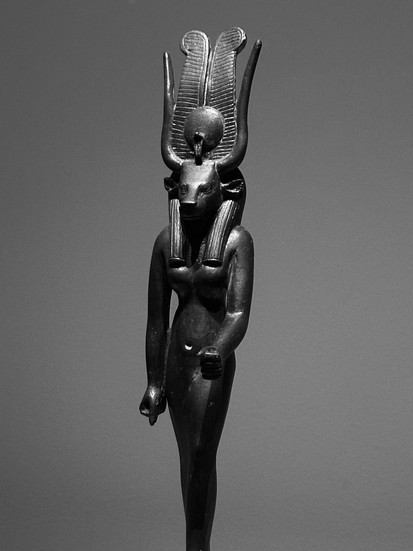


Presiding the Opening of the Mouth ceremony and the Weighing of the Heart ceremony over the mummification, Anubis is one of the oldest funerary gods. It combines the features of various canids, which roamed the edges of the desert and had the habit of consuming carrion. Ancient Egyptians transformed this destructive power into a protective force as guardian of the dead.
Cows that gave birth to an Apis bull were considered the incarnation of the goddess Isis. They enjoyed a life of high esteem within the temple and were mummified after death, accorded a grand funeral and buried in a dedicated catacomb at the Saqqara necropolis. This statue was made of cartonnage over a wooden frame, which contains partial remains of a calf.
The dung beetle rolled a ball of dung across the sand. From earliest times, the Ancient Egyptians associated this action with the daily movement of the sun across the sky and with the sun god, who is reborn each dawn. Literally meaning “that which comes into being”, the scarab was therefore believed to protect the wearer in this new life and the spiritual rebirth in the afterlife.
Title: Ancient Egypt Unveiled: Treasures from Egyptian Museums
Date: 20 November 2025 to 31 August 2026
Location: M+, Hong Kong
Curator: Hong Kong Palace Museum, Supreme Council of Antiquities of Egypt


留言