
A Melting Pot in Bakery
- 6月12日
- 讀畢需時 4 分鐘
There are hundreds and thousands of bakeries in Hong Kong. For example in the Admiralty train stations, one could find at least 10 shops selling bread and cookies. From dough to table, bread remains central to our daily life, combining craftsmanship, regional techniques and long-standing traditions. Shall we trace the origin for some of these local common bread together?
Pineapple Bun (菠蘿包)

Containing without pineapple, it earns its moniker from its golden-brown, cracked cookie crust that resembles the texture of the fruit, as well as the Melonpan of Japan. Emerged in the 1940s to cater to the working class, it was listed as an intangible cultural heritage in 2014 in Hong Kong.
Cocktail Bun (雞尾包)

As a resourceful way to reduce food waste, bakers repurposed the unsold and day-old bread by grinding it with sugar and coconut to create a new and sweet filling. Modern recipes use freshly made milk bread dough. The term "cocktail" resembled a bartender mixing various liquors.
Gua Bao (刈包) [Cantonese: ngai6]

A popular snack in East and Southeast Asia, the Gua Bao is filled with a slice of stewed meat and condiments. Instead of baking the dough made with high protein flour, Bao is made with low protein one and locks its moisture via steaming, resulting in a dense crumb without a hard crust.
Dorayaki (銅鑼燒)

Invented by a Usagiya in Tokyo, Japan, this confection consists of two fluffy honey pancakes filled with sweet red bean paste. It is the anime character Doraemon’s favorite food.
Croissants (牛角包)

While eating croissants in Paris is prioritized in the to-do-list of Emily Cooper, croissants actually originated in Austria, not France. Their ancestor is the kipferl, a dense crescent-shaped bread that traces back to 13th-century Vienna. Legend has it that the crescent shape was created by Viennese bakers in 1683 to celebrate the defeat of the Ottoman Empire.
Baguette (長棍麪包)

As a UNESCO Intangible Cultural Heritage, “baguette de tradition française” must be made on-site, using strictly four ingredients, which are wheat flour, water, common kitchen salt, yeast and/or sourdough and never be frozen. It is protected by the Décret Pain of 1993, aka “Baguette Law”, in order to protect the authenticity and quality of traditional French bread.
Sandwich (三文治)

In 1762, the Earl of Sandwich refused to leave the gaming table for a proper meal, he asked his cook to bring him roast beef placed between two slices of bread, allowing him to eat without greasing his cards one-handedly. Thus, the term “sandwich” originated from this English man.
Egg Tart (蛋撻)

Beginning with European custard tarts, which were served at the royal banquets in England in the 14th century, Monks in Lisbon created the pastel de nata to use up leftover egg yolks, with a caramelized custard top and a pastry crust. The British-colonised Hong Kong evolved its version with Chinese egg custard and lard, making it a staple at “cha chaan tengs” and dim sum parlors.
Donut (冬甩)

The Dutch used to make fried dough balls called olykoeks (aka oily cakes). In the 17th century, the Dutch settlers brought the recipes to New York. As the centers of this pastry remained raw, they stuffed them with fruit or nuts, inspiring the literal descriptive term “dough nut”.
Bagel (貝果)

Legend has it that a Viennese baker invented the bagel in 1683, as a way to honor King John III Sobieski of Poland. Some said Bagels originated in the Jewish communities of Poland in the 16th century. The word derived from a Germanic word meaning “ring” or “bracelet”. In the late 19th and the early 20th centuries, Eastern European Jewish immigrants brought it to North America.
Danish Stick (丹麥條)

Rolled into a twisted baton and baked to a flak and crispy texture, it is an adaptation of the Viennese-Danish pastry dough wienerbrød. This Danish pastry was created as the Copenhagen bakery hired Austrian bakers who adapted their traditional laminated, flaky dough techniques.
Garlic Bread (蒜蓉包)

Inheriting the Ancient Rome tradition, olive oil and raw garlic was put on top of the Italian bruschetta, without using butter. When immigrants settled in the USA in the 1900s, these Italians had to replace it with butter on baguettes. As time went by, it became popular again among the Italian-American restaurants, serving as a comforting side to accompany pasta and pizza.
Mexico Bun (墨西哥包)
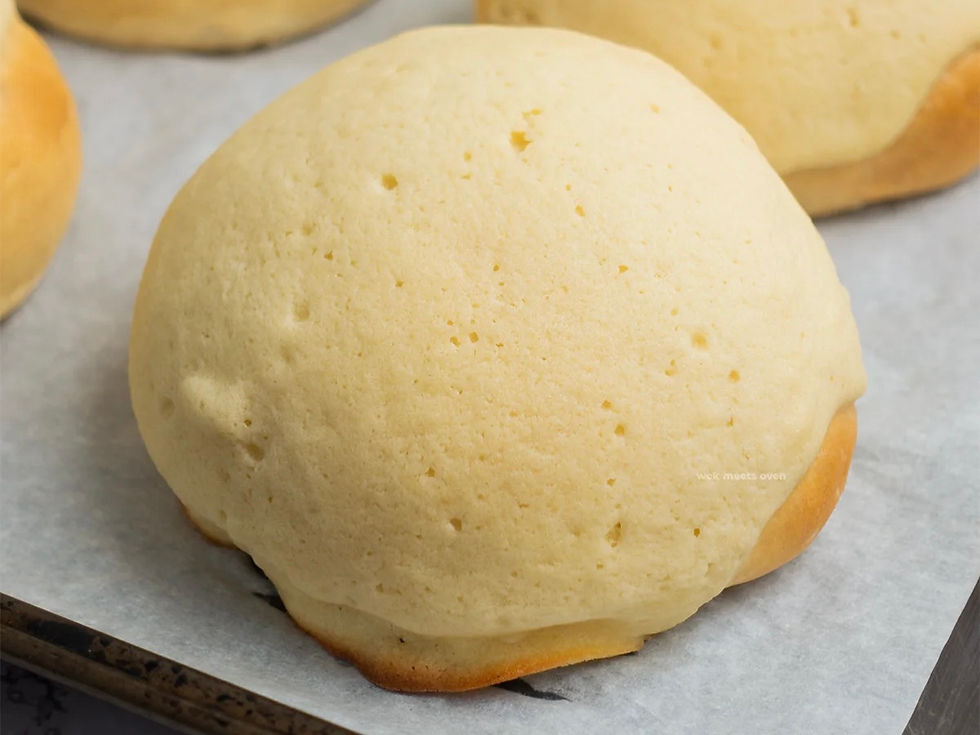
It was created in Hong Kong in 1946 by Chinese-Mexican families returning to Asia under the anti-Chinese sentiment in the 20th century. A tribute to the traditional Mexican sweet bread concha, blending its panaderia technique with soft milk bread and custard filling in Hong Kong.
Cheese Mochi Balls (芝士麻糬波波)

Pão de Queijo originated from Brazil in the 18th century, where enslaved Afro-Brazilians used cassava root to extract tapioca starch and mixed with dairy products, making these cheese snack chewy. This pastry arrived in Japan due to the return of dekasegi and evolved into mochi donut.
Naan (饢)

Popular in South Asian and Middle Eastern cuisines, the word “naan” comes from the Persian word nān, simply meaning bread. Unlike unleavened flatbreads like roti, naan dough is enriched with yogurt, milk, and yeast (or baking powder), which creates a fluffier texture with air pockets.
What is your favourite pastry in your hometown? For me, there used to be a local bakery, selling a chicken sandwich with a combination of a pan-fried chicken and fresh lettuce. It reminds me how crispy the chicken and how crunchy the lettuce are. What is it but a delicious and healthy after-school snack? Its customized taste is an irreplaceable childhood memory of mine.


留言